
Air sampling and surface sampling answer different questions.
Air sampling tells you what mold particles were present in the air during the sampling period. Surface sampling tells you what was collected from a specific surface.
Neither test gives a complete picture of the entire property by itself. The results should be considered together with the visual inspection, moisture conditions, and reason for testing.
Air Sampling vs. Surface Sampling: Quick Comparison
Air Sampling | Surface Sampling | |
What is tested? | Airborne particles | Material on a surface |
What does it show? | What was airborne at that time | What was present at that specific location |
Best used for | Investigating airborne concerns and comparing areas | Evaluating visible or suspect material |
Main limitation | Conditions can change | Only represents the sampled spot |
Neither method is automatically better. The correct test depends on what the inspector is trying to determine.
What Does Mold Air Sampling Tell You?

Air sampling collects particles from the air for laboratory analysis.
It can help show:
- What fungal material was airborne during the test
- How one indoor area compares with another
- How indoor results compare with an outdoor sample
- Whether results support further investigation
EPA guidance explains that an air sample represents conditions only during the period when the sample was collected.
That means air testing is a snapshot, not a continuous measurement of conditions inside the property.
What Air Sampling Cannot Tell You
An air test does not automatically tell you:
- Exactly where mold is growing
- Whether mold is hidden behind a wall
- Whether every room is affected
- Whether a property is completely mold-free
- Whether a building “passes” or “fails”
There is also no federal EPA standard that defines a universally acceptable number of airborne mold spores.
So results should not be treated as a simple safe-or-unsafe score.
What Does Surface Sampling Tell You?
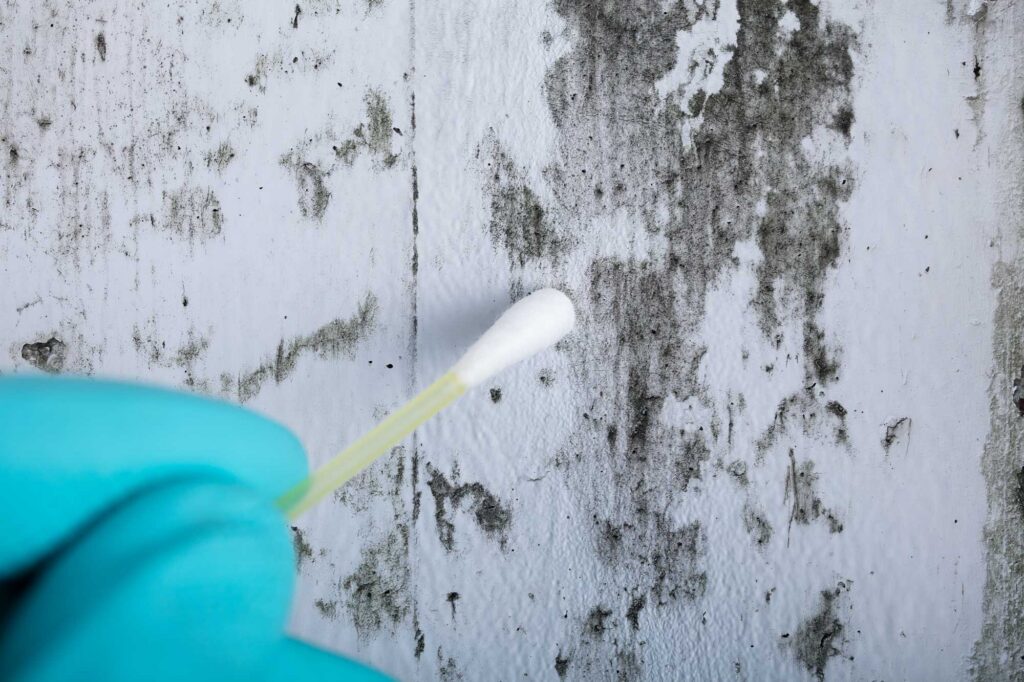
Surface sampling collects material directly from a specific area.
Common methods may include tape or swab samples.
Surface sampling can help answer questions such as:
- Is this suspicious growth actually mold?
- What was present on this particular surface?
- Does a specific area need further evaluation?
EPA notes that sampling may sometimes help distinguish mold from substances such as dirt or soot.
Surface sampling can also sometimes be useful after remediation when evaluating a particular cleaned area.
What Surface Sampling Cannot Tell You
A surface sample does not tell you:
- What is happening elsewhere in the property
- Whether spores are airborne
- How far a moisture problem extends
- Whether mold is hidden behind the sampled material
A sample from one wall represents that sampled area, not the whole home.
Which Mold Test Is Better?
Neither.
The better question is:
What are you trying to find out?
Air sampling may make sense when the concern involves:
- Airborne mold
- A musty odor with no obvious source
- Comparing different indoor areas
- Comparing indoor and outdoor conditions
Surface sampling may make more sense when:
- Growth is visible
- A stain needs to be identified
- A particular material needs evaluation
- A specific remediated area is being checked
The sampling method should match the question.
Do You Need Both Air and Surface Sampling?
Not always.
Some mold assessments may use air sampling, some may use surface sampling, and some may not require sampling at all.
EPA states that when mold is already clearly visible, sampling is generally unnecessary unless the results would change how the problem is handled.
New York State also advises property owners to ask why a particular mold test is being recommended and what information it will provide that is not already known.
The Bottom Line
Air samples tell you what was airborne during a specific sampling period. Surface samples tell you what was present on a specific surface.
Neither test should be used without a clear reason.
The best approach is to first evaluate the property, moisture conditions, visible concerns, and history of water damage—then determine whether air sampling, surface sampling, or no sampling at all is appropriate.